As always, being a social media marketer requires one to be Always Learning. It’s one of our core values. To help, we recently completed the 2025 version of our Ignite Social Media Trends Survey, and we can now compare it to 2024. While the number of responses was relatively small in both years, we found some interesting trends and a few important nuggets showing how social media marketers work today.
Social Media Performance is Still Best with Video, But Other Content Types Are Holding Their Own
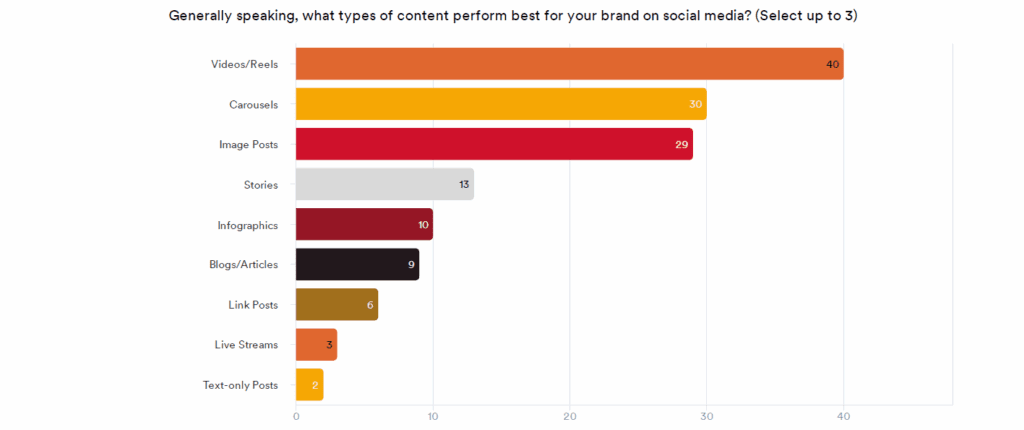
When it comes to what content works best for social media marketing, the results were consistent. Videos/Reels were overwhelmingly the top-performing content type in both years. So if you’re focusing on short-form video, you’re on the right track.

However, the survey also highlighted the continued importance of other formats:
- Carousels and Image Posts were consistently ranked as the second and third most effective types of content.
- Infographics saw a small but notable increase in popularity, which may suggest a growing need for easily digestible data visualization.
The takeaway here is that while video is a must-have, a diverse content strategy is key to success. We’ve found repeatedly with our clients that relying on one post type leads to poor performance.
Engagements and Reach Remain Most Common Metrics for Social Media Marketers
Engagements, reach, and follower growth were far more common metrics for social media marketers to focus on in 2025 than things like conversion rates, ROAS, or cost per acquisition.

While we always prefer to align as closely as possible to business metrics, it can be challenging for smaller brands or brands that sell through retail (among others), to track hard outcomes.
If you do need to focus on these awareness metrics, we’d suggest that reach is much more important than follower growth. Channels just aren’t rewarding large follower counts like they used to.
Since engagements, reach, and follower counts are universally available to all social accounts, it’s not surprising that they are commonly used. We would suggest, however, that all brands conduct a thorough analysis to identify social media metrics that better align with overall marketing and business metrics.
Social Media Marketers Biggest Challenges
When we asked social media marketers their biggest pain points, the number one challenge in both years was “generating engagement”. The percentage selecting this increased in 2025, showing that connecting with your audience is getting harder. It also coincides with two factors:
-
-
- Engagement rates are falling across the board; and
- Most platforms no longer count video views as engagements.
-
Creating content dropped from the second biggest struggle to the fifth biggest, while “being asked to do too much” increased from third place to second. “Getting budget” moved up one spot, from the fourth biggest challenge to the third. “Analyzing results” held steady in the sixth spot.

In a positive sign, “getting approvals” showed a significant decrease in terms of challenges, which could mean that internal workflows are becoming more streamlined, and leadership teams are trusting their social media marketers more.
Over 90% of Social Media Marketers are Using AI
The biggest surprise from the survey data may be the changing perception of AI. While 18% of social media marketers surveyed in 2024 said they were not currently using AI, that number dropped to only 9% in 2025.
Most social media marketers, however, are staying away from AI generated imagery, given the frequent backlash to brand use of AI imagery. They are using it, however:
- 40% of social media marketers report using AI-assisted text for social content.
- 25% are using it for help with brainstorming concepts or campaigns.
- 12% are using it for AI-generated imagery.
- 11% are using it for AI-assisted responses for engagement or replies.
AI is not making life easier for marketers, however. 46% report no impact on their need for resources, but 30% report significant or moderate need for increased resources because of AI, while only 14% report a modest decrease in the need for resources.
The Budget Squeeze
When it comes to budgets, it appears many teams are facing a more cautious financial environment in 2025.
Stagnant Budgets: The most common response in 2025 was that budgets “remained the same” (64.29% of respondents), a significant jump from 48.54% in 2024.
Fewer Increases: The percentage of teams reporting a budget increase dropped by half, from 32.04% in 2024 to just 16.07% in 2025. This is likely caused by economic uncertainty in the first half of 2025.
Job Satisfaction with Social Media Marketing Career
In our survey, 66% of social media marketers report being somewhat or very happy with their career, versus only 11% who are somewhat unhappy. Another 23% were more neutral, saying they were neither happy nor unhappy.

Leadership Value: A Growing Divide
Finally, how leadership views social media seems to be becoming more extreme.
Increased Support: The percentage of respondents who said their leadership “highly values” social media saw a slight increase from 37.5% in 2024 to 39.29% in 2025.
Increased Skepticism: At the same time, the percentage of leaders who “minimally value” or “do not value” social media also saw a small increase. This suggests that while some leaders are becoming bigger believers, others are becoming more skeptical, creating a wider gap in perception.
Wrapping It Up
Our latest survey data shows that social media marketing is as dynamic as ever. While tried-and-true tactics like video content and native platforms remain important, marketers are clearly shifting their focus toward brand awareness over immediate conversions. At the same time, the struggle to generate engagement and find expert support is growing, highlighting a need for new strategies and resources to succeed.
The survey was conducted online in June and July of 2025 and compared to a similar survey conducted over the same period in 2024. The sample sizes in 2024 and 2025 were 101 and 56, respectively, indicating that minor adjustments in percentages are not statistically significant.